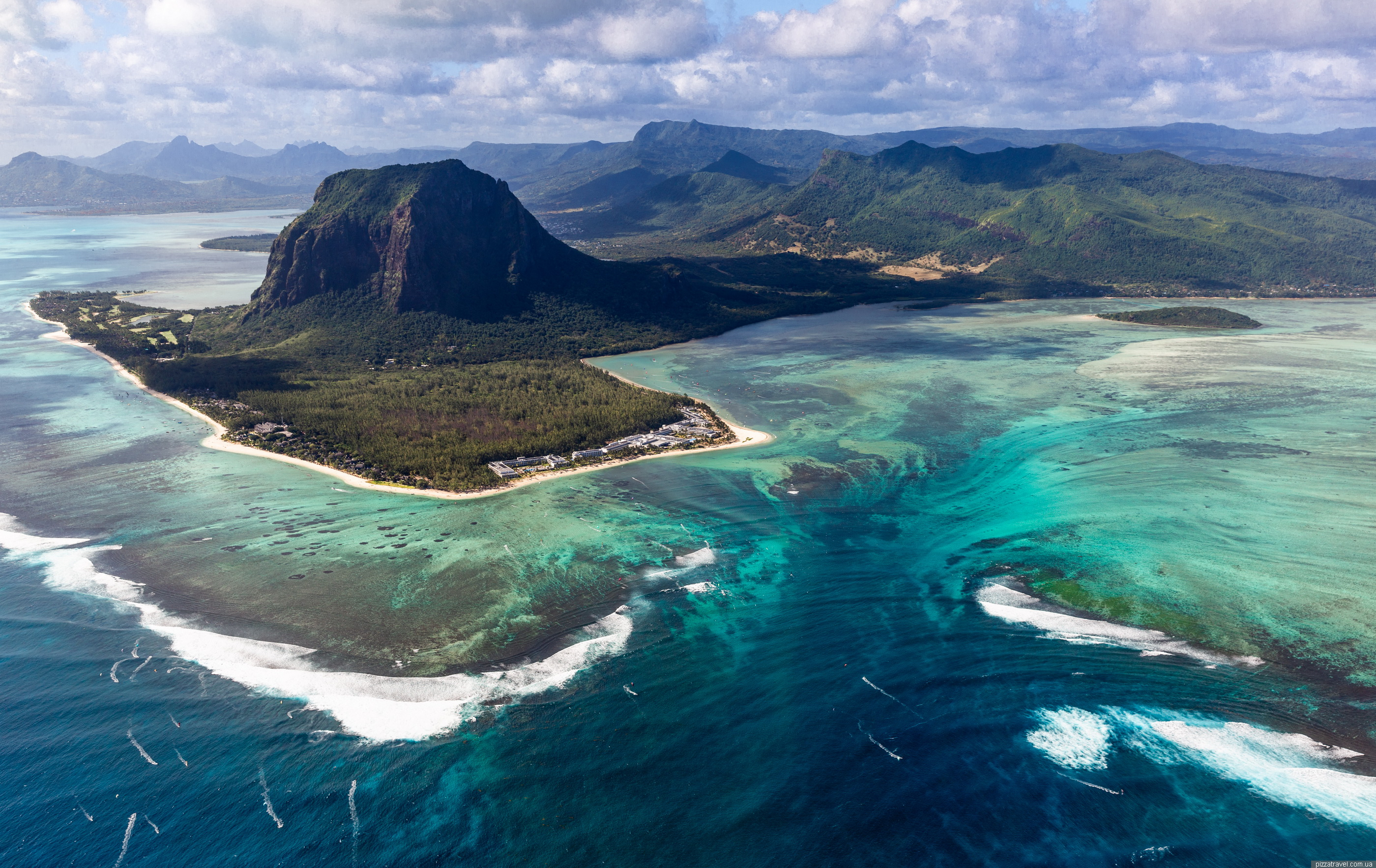
Flying over an underwater waterfall ©Yuriy Buriak
In fact, there is no waterfall there. This phenomenon is explained by the underwater topography and the movement of sand. Near the coast, the ocean floor drops sharply, and currents wash the light-coloured sand from the shallows into deeper areas. Combined with the varying shades of the water, this creates the illusion of a stream ‘flowing’ downwards.
It’s impossible to see the waterfall from the ground, or even from Le Morne Brabant. In theory, it’s possible from a drone, but I couldn’t manage it. The first problem is that you have to fly very far and very high, and not every drone is capable of that. The second problem is the tourist planes, which fly from 9 am to 5 or 6 pm, which is precisely when the waterfall is best lit by the sun. Obviously, you can’t fly a drone at that time. I tried taking off after 6 pm, but by then the waterfall was no longer visible.
So, if you want to see the waterfall, you’ll need to book a flight on a small plane. As of 2026, tourists are flown by LagoonFLIGHT (https://lagoonflight.com), whose planes take off from the beach located here -20.483389, 57.353500.

Flying over an underwater waterfall ©Yuriy Buriak

Flying over an underwater waterfall ©Yuriy Buriak
Only one passenger can be on board a plane at a time, but it is possible to fly in two planes simultaneously, which is exactly what we did. We flew two circuits; first, one plane was closer to the waterfall, then the other.

Flying over an underwater waterfall ©Yuriy Buriak
You can open the window on the plane, but be quick – you’ll only have 15–20 seconds. If you’re just filming on your smartphone, that’s plenty of time, but if you want to take both photos and videos, and use different devices to do so, it’ll be a bit of a struggle, as it was for me.
Our hotel is down there.

Flying over an underwater waterfall ©Yuriy Buriak
After the waterfall, we flew a little further along the south coast.

Flying over an underwater waterfall ©Yuriy Buriak

Flying over an underwater waterfall ©Yuriy Buriak

Flying over an underwater waterfall ©Yuriy Buriak

Flying over an underwater waterfall ©Yuriy Buriak